
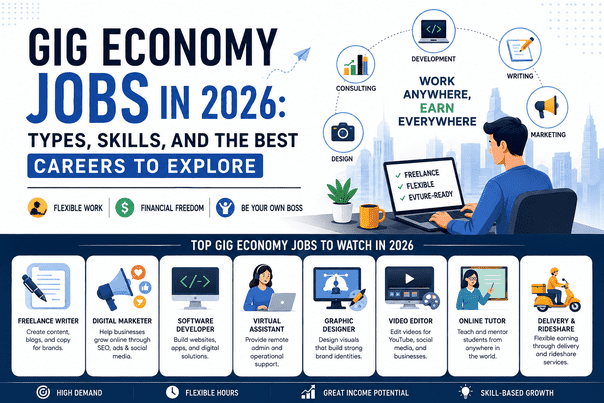
The gig economy is changing how people work, earn, and build careers. Discover the best gig economy jobs in 2026, the different types of gig work, essential skills, earning opportunities, and how to get started.
The modern workforce is evolving faster than ever, and one of the biggest changes in recent years has been the rise of gig economy jobs.
From freelance writers and software developers to digital marketers, online tutors, delivery professionals, and independent consultants, people across industries are increasingly choosing flexible, project-based work instead of relying entirely on traditional 9-to-5 employment.
As digital platforms, remote work, artificial intelligence, and global connectivity continue to reshape the workplace, the gig economy is creating new opportunities for people with different skills, backgrounds, and career goals.
If you’re a student looking for flexible work, a professional interested in freelancing, someone searching for a side income, or an experienced worker considering independent employment, understanding the gig economy can help you make better career decisions.
In this guide, we’ll explore what the gig economy is, the different types of gig economy jobs, the best gig jobs to consider in 2026, the skills required to succeed, the advantages and challenges of gig work, and how you can start building a career in this growing sector.
What Is a Gig Economy?
The gig economy refers to a labor market in which temporary, flexible, freelance, or project-based jobs are common instead of traditional permanent employment.
In a gig economy, workers may be hired for a specific project, assignment, service, or period rather than becoming permanent employees of one organization.
Digital platforms have made this model easier to access. Freelancers can find clients through online marketplaces, while businesses can hire skilled professionals from different locations based on their immediate requirements.
Examples of gig economy platforms and services include freelance marketplaces, delivery services, transportation platforms, online tutoring platforms, and professional networking channels.
Unlike traditional employment, gig workers generally have greater control over when, where, and for whom they work.
For example, a freelance graphic designer may work with five different clients in one month. A software developer may accept short-term development projects. An online tutor may teach students from different countries, while a digital marketing specialist may manage SEO or social media campaigns for several businesses.
This flexibility is one of the major reasons gig work has become increasingly attractive to students, professionals, freelancers, and entrepreneurs.
However, gig work also requires greater responsibility. Workers need to find clients, manage deadlines, negotiate rates, maintain professional relationships, and often manage their own taxes, insurance, and financial planning.
Common Types of Gig Economy Jobs
Gig economy jobs exist across almost every major industry. The type of work you choose will depend on your skills, experience, interests, and preferred working style.
Here are some of the most common categories of gig work:
| Category | Examples of Gig Jobs | Work Style |
|---|---|---|
| Freelance Writing | Blog writing, copywriting, technical writing | Remote, project-based |
| Digital Marketing | SEO specialist, PPC manager, social media strategist | Remote/Hybrid |
| Tech & IT | Web developers, app developers, software testers | Remote, high-paying |
| Creative Design | Graphic designers, video editors, UX/UI designers | Remote or hybrid |
| Transportation | Rideshare drivers, delivery services | In-person |
| Personal Services | Tutors, fitness trainers, virtual assistants | Remote/In-person |
| Skilled Trades | Electricians, plumbers, handymen | In-person |
The important thing to understand is that gig work is not limited to low-skilled or temporary jobs.
Many highly skilled professionals now work independently and earn income through consulting, software development, design, marketing, writing, data analysis, coaching, and other specialized services.
Types of Gig Jobs to Explore
There are several ways to categorize gig economy jobs. Your ideal option depends on your skills, lifestyle, career goals, and whether you prefer remote or in-person work.
1. Remote Gig Jobs
Remote gigs can be performed from home or virtually anywhere with a reliable internet connection.
Examples include:
- Freelance writing
- Graphic design
- Web development
- Software development
- SEO
- Digital marketing
- Online tutoring
- Virtual assistance
- Video editing
- Consulting
Popular platforms for finding remote freelance opportunities include Upwork, Fiverr, Freelancer, and specialized professional networks.
2. In-Person Gig Jobs
Not every gig job can be performed online.
In-person gig opportunities include:
- Delivery services
- Rideshare driving
- Pet sitting
- Photography
- Fitness training
- Home repair
- Event support
- Local tutoring
- Personal services
These jobs can be particularly attractive to people who prefer practical, location-based work.
3. Platform-Based Gig Jobs
Platform-based gig work involves finding clients or assignments through a digital marketplace.
Examples include:
- Freelance marketplaces
- Delivery platforms
- Task-based service platforms
- Online tutoring platforms
- Design marketplaces
These platforms can make it easier for beginners to find their first clients because they provide an existing marketplace.
However, competition can be high, so having a strong profile, portfolio, reviews, and clearly defined services can make a significant difference.
4. Independent Gig Work
Experienced professionals may choose to find clients independently rather than depending entirely on gig platforms.
They can use:
- Personal websites
- Professional networking
- Referrals
- Email outreach
- Industry communities
- Existing professional contacts
Independent gig work can offer greater control over pricing, client relationships, and business development.
| Gig Job Type | Best For | Platforms/Examples |
| Remote Gigs | Writers, designers, developers, teachers | Upwork, Fiverr, Toptal |
| In-Person Gigs | Delivery, pet sitting, photography | Local platforms and services |
| Platform-Based Gigs | Beginners looking for clients | Freelancer, TaskRabbit, Fiverr |
| Independent Gigs | Experienced professionals | Personal website, LinkedIn, referrals |
Advantages of the Gig Economy for Employers and Employees
The gig economy can benefit both workers and businesses.
For workers, the biggest attraction is flexibility. For employers, gig workers can provide access to specialized talent without requiring a permanent full-time hire for every project.
| For Employees | For Employers |
| Flexible schedules | Access to specialized talent |
| Better control over work | Potentially lower hiring overhead |
| Ability to work with multiple clients | Flexible workforce |
| Opportunity to build new skills | Ability to scale teams based on demand |
| Location independence for remote work | Access to talent from different locations |
| Opportunity to develop an independent career | Support for short-term or project-based requirements |
Benefits for Workers
Flexible Work Schedules
Gig workers can often decide when they want to work, depending on the type of gig and client requirements.
This can be especially useful for students, parents, professionals with other responsibilities, and people building a side business.
Multiple Sources of Income
Instead of relying on one employer, freelancers can work with multiple clients.
This can create opportunities to diversify income, although it also requires effective financial and workload management.
Skill Development
Working with different clients and projects can expose gig workers to new industries, technologies, tools, and business problems.
Over time, this can help professionals build a broader portfolio of experience.
Location Independence
Many digital gig jobs can be performed remotely, allowing professionals to work with clients outside their city or even outside their country.
Benefits for Employers
Businesses can use gig workers when they need specialized expertise, additional capacity, or short-term project support.
For example, a startup may hire a freelance designer for branding, an SEO specialist for a website project, or a software developer for a specific technical requirement.
This allows companies to access specialized skills without necessarily creating a permanent position.
The Best Gig Economy Jobs in 2026
The best gig economy job for you depends on your skills, experience, income expectations, and career goals.
However, several areas continue to offer strong opportunities as businesses increasingly depend on digital platforms, online marketing, technology, and remote services.
Here are some gig economy careers worth exploring in 2026:
| Gig Economy Job | Why It Is Popular |
| Freelance Writer | Businesses need blogs, website content, copywriting, and marketing content |
| Digital Marketing Specialist | Businesses need SEO, advertising, social media, and online growth |
| Software Developer | Strong demand for websites, applications, software, and digital products |
| Virtual Assistant | Businesses need remote administrative and operational support |
| Graphic Designer / Video Editor | Brands need visual content for websites and social media |
| Online Tutor | Remote education and skill development continue to create opportunities |
| Delivery / Rideshare Driver | E-commerce, transportation, and local delivery create flexible work |
| Fitness & Wellness Coach | Online coaching and personalized wellness services are growing |
Let’s look at some of these opportunities in more detail.
1. Freelance Writer
Writing remains one of the most accessible digital gig careers.
Freelance writers can work on:
- Blog posts
- Website content
- Product descriptions
- Email newsletters
- Copywriting
- Technical documentation
- Social media content
- Scripts
- Case studies
Writers with specialized knowledge in areas such as technology, finance, healthcare, education, or business can potentially differentiate themselves from general writers.
2. Digital Marketing Specialist
Businesses of all sizes need digital marketing to attract customers online.
Freelance digital marketers may specialize in:
- Search engine optimization (SEO)
- Social media marketing
- Paid advertising
- Content marketing
- Email marketing
- Analytics
- Local SEO
- Conversion optimization
Digital marketing can be particularly attractive as a gig career because businesses often hire specialists for specific campaigns or ongoing services.
3. Software Developer
Software development is one of the more specialized and potentially high-paying areas of gig work.
Freelance developers can work on:
- Websites
- Mobile applications
- Business software
- APIs
- Automation
- E-commerce platforms
- AI-powered applications
- Software testing
Developers can work with startups, small businesses, agencies, and larger organizations.
4. Virtual Assistant
Virtual assistants provide administrative and operational support remotely.
Typical responsibilities can include:
- Email management
- Calendar management
- Data entry
- Customer support
- Research
- Scheduling
- Social media assistance
- Basic bookkeeping
- Administrative coordination
This can be a practical entry point for people who have strong organizational and communication skills.
5. Graphic Designer and Video Editor
Visual content has become essential for businesses, creators, brands, and social media professionals.
Freelance designers and video editors can work on:
- Social media graphics
- YouTube videos
- Advertisements
- Presentations
- Logos
- Brand materials
- Short-form videos
- Promotional content
Professionals who combine design skills with an understanding of branding, marketing, and AI-powered creative tools can create additional value for clients.
6. Online Tutor
Online tutoring allows teachers and subject-matter experts to work with students remotely.
Popular tutoring areas include:
- Mathematics
- Science
- Languages
- Coding
- Test preparation
- Professional skills
- Music
- Career development
Tutoring can be particularly suitable for students, teachers, working professionals, and subject-matter experts looking for flexible income.
7. Delivery and Rideshare Work
Transportation and delivery services are another major part of the gig economy.
Workers can earn income through:
- Food delivery
- Package delivery
- Rideshare services
- Local transportation
- On-demand delivery
These jobs can provide flexibility, although earnings and expenses can vary significantly by location, working hours, platform, fuel costs, and demand.
8. Fitness and Wellness Coaching
Fitness professionals and wellness coaches can increasingly provide services both in person and online.
Examples include:
- Personal training
- Online fitness coaching
- Nutrition-related coaching where appropriately qualified
- Yoga instruction
- Lifestyle coaching
- Customized workout programs
Building a strong personal brand and online presence can help independent coaches attract clients beyond their local area.
What Skills Are Best for Gig Work?
Technical skills are important, but successful gig workers need more than technical expertise.
Because independent professionals are responsible for finding clients, managing projects, meeting deadlines, and maintaining relationships, a combination of hard skills and soft skills is essential.
1. Time Management
Gig workers often manage several projects or clients simultaneously.
Strong time-management skills help you:
- Meet deadlines
- Prioritize tasks
- Avoid overbooking
- Maintain consistent quality
- Balance multiple clients
2. Communication Skills
Clear communication is essential when working independently.
You should be able to:
- Understand client requirements
- Ask relevant questions
- Provide project updates
- Explain your ideas
- Handle feedback professionally
- Communicate delays when necessary
3. Adaptability
The gig economy changes quickly.
Clients may adopt new tools, technologies, platforms, and business models. Professionals who can learn quickly and adapt to changing requirements are more likely to remain competitive.
4. Digital Literacy
Most modern gig workers need basic digital competence.
Depending on your career, this may include:
- Online collaboration tools
- Project management platforms
- Video conferencing
- Digital payment systems
- Cloud storage
- AI tools
- Professional networking platforms
- Freelance marketplaces
5. Self-Motivation
Traditional employees may have managers and structured schedules.
Gig workers often need to create their own structure.
Self-motivation helps you maintain productivity even when you are working independently.
6. Specialized Knowledge
Specialization can help freelancers stand out in competitive marketplaces.
Examples include:
- Artificial intelligence
- Data analytics
- Cybersecurity
- UX/UI design
- SEO
- Software development
- Blockchain
- Financial analysis
- Technical writing
The more clearly you can demonstrate a valuable and specialized skill, the easier it can become to position yourself as an expert rather than competing solely on price.
Why Gig Economy Jobs Are the Future of Work
The traditional 9-to-5 employment model is no longer the only path to career growth.
Remote work, digital platforms, artificial intelligence, online marketplaces, and global connectivity have created new ways for professionals to sell their skills.
For workers, gig economy jobs can provide:
- Flexibility
- Career independence
- Multiple income opportunities
- Exposure to different industries
- Remote work opportunities
- Faster skill development
For businesses, gig workers can provide:
- Specialized expertise
- Flexible staffing
- Access to global talent
- Project-based support
- Faster scaling
- New perspectives and innovation
Artificial intelligence is also changing the nature of gig work.
Some routine tasks may become increasingly automated, while demand can grow for professionals who know how to use AI effectively alongside human expertise.
For example, a writer who understands AI-assisted research and editing can potentially work more efficiently, while a developer who understands AI-powered development tools can offer new services to clients.
The important lesson is not simply to compete against technology, but to learn how to use technology to increase your value.
As companies continue to adopt flexible working models and professionals seek greater control over their careers, gig economy jobs are likely to remain an important part of the future of work.
Gig Economy Jobs: Your Roadmap to Career Success
The gig economy has transformed how we think about careers, jobs, and professional success.
Whether you want to work part-time, earn additional income, gain practical experience, or build a full-time freelance career, gig work can provide a variety of opportunities.
However, successful gig work requires more than simply joining a platform.
Step 1: Identify Your Skills
Start by listing the skills you already have.
Consider:
- What are you good at?
- What problems can you solve?
- What services could someone pay you for?
- Which skills do you enjoy using?
Step 2: Choose a Specific Service
Avoid trying to offer everything.
Instead of saying:
“I can do digital marketing.”
You could position yourself more specifically:
“I help small businesses improve their local SEO and Google search visibility.”
A clear service makes it easier for potential clients to understand your value.
Step 3: Build a Portfolio
A portfolio demonstrates what you can actually do.
If you are a beginner without previous clients, create sample projects.
For example:
- A writer can create sample articles.
- A designer can create mock branding projects.
- A developer can build sample applications.
- An SEO professional can prepare a sample website audit.
- A video editor can create sample short-form videos.
Step 4: Create a Professional Online Presence
Your digital presence can influence whether clients trust you.
Consider creating or improving:
- LinkedIn profile
- Freelance platform profile
- Personal website
- Portfolio
- Professional email address
Step 5: Start Finding Clients
You can search for clients through:
- Freelance marketplaces
- Personal networking
- Referrals
- Cold outreach
- Professional communities
- Industry-specific platforms
Step 6: Build Your Reputation
Your first projects are not only about income.
They can help you build:
- Client reviews
- Testimonials
- Portfolio pieces
- Industry experience
- Professional relationships
- Referrals
Step 7: Keep Learning
The most valuable skill in the gig economy may be the ability to continuously learn.
Technology, client expectations, and market demand change quickly.
Professionals who continuously improve their skills can position themselves for better projects and higher-value opportunities.
Frequently Asked Questions About Gig Economy Jobs
How do I start working in the gig economy?
Start by identifying your strongest skills and choosing the type of gig work that matches your experience. Create a professional profile or portfolio, choose relevant platforms, and begin applying for projects that match your abilities.
If you are a beginner, consider starting with smaller projects to build experience, reviews, testimonials, and confidence.
What are the highest-paying gig economy jobs?
Some of the potentially higher-paying gig careers include software development, digital marketing, consulting, specialized technical services, AI-related work, UX/UI design, data analytics, and other specialized professional services.
Actual earnings vary depending on your expertise, experience, location, niche, client base, and ability to demonstrate value.
Can gig economy jobs provide a stable income?
Yes, gig work can provide a stable income for some professionals, particularly those who develop specialized skills, maintain multiple client relationships, build repeat business, and manage their finances carefully.
However, gig income can fluctuate. Unlike a traditional salary, there may be periods with fewer projects or clients.
Building an emergency fund and diversifying your client base can help reduce financial risk.
Are gig economy jobs only for freelancers?
No.
The gig economy includes a wide range of temporary, flexible, part-time, and project-based work.
A person with a full-time job may also take on freelance work as a side income, while a student may complete small projects to gain experience and earn money.
How much can I earn in gig economy jobs?
There is no single income level for gig work.
Earnings depend on:
- Your skill level
- Industry
- Experience
- Location
- Client type
- Project complexity
- Number of hours worked
- Pricing strategy
- Reputation and portfolio
Entry-level work may command lower rates, while experienced professionals with specialized skills can charge significantly higher rates.
Instead of focusing only on hourly income, gig workers should also consider the time spent finding clients, communicating with them, managing projects, and handling administrative responsibilities.
Which platforms are best for finding gig economy jobs?
The best platform depends on the type of work you want to do.
Popular options include:
- Upwork
- Fiverr
- Freelancer
- Toptal
- TaskRabbit
- Specialized freelance marketplaces
- Industry-specific platforms
Before choosing a platform, compare its fees, competition, payment systems, available jobs, and suitability for your particular skill set.
Are gig economy jobs right for students or beginners?
Yes.
Many gig jobs can be suitable for students and beginners because they offer flexible schedules and opportunities to gain practical experience.
Students can explore areas such as:
- Writing
- Graphic design
- Video editing
- Online tutoring
- Social media management
- Virtual assistance
- Web development
- Data-related work
Starting with smaller projects can help beginners develop a portfolio while learning how professional client relationships work.
What skills are in demand for gig economy jobs in 2026?
In-demand skills can vary by market, but strong opportunities exist across areas such as:
- Digital marketing
- Artificial intelligence
- Software and web development
- Data analytics
- Content creation
- UX/UI design
- Video production
- SEO
- Project management
- Specialized consulting
The strongest opportunities are often found where technical expertise is combined with business understanding, communication, creativity, and problem-solving ability.
Final Thoughts
The gig economy is changing the traditional definition of a career.
You no longer have to depend entirely on one employer or follow a single career path for decades. With the right skills, technology, professional network, and entrepreneurial mindset, you can build income through multiple projects and clients.
For students, gig work can provide valuable real-world experience.
For professionals, it can create additional income and career flexibility.
For experienced specialists, it can become a full-time independent career.
The key is to identify a valuable skill, build proof of your ability, develop a professional online presence, and continuously adapt to changing market demand.
The future of work is becoming more flexible, more digital, and increasingly skills-driven. If you’re ready to take control of your career, exploring gig economy jobs could be a valuable step toward building a more flexible and independent professional future.

One Comment
Hi, this is a comment.
To get started with moderating, editing, and deleting comments, please visit the Comments screen in the dashboard.
Commenter avatars come from Gravatar.